Coupled Pendulums and the Mystery of Dark Matter
Any student in a high school or undergraduate science lab has probably come across the coupled pendulum system. It’s a beautiful little experiment that looks simple but hides deep physics.
Imagine two pendulums connected by a spring. If you flick one pendulum, it starts oscillating. After a while, the motion seems to fade away—only to show up in the other pendulum! Then, after some time, the energy flows back to the first one. This back-and-forth continues until friction eventually damps the motion in real life.
Video credit: Original YouTube source
Now you might ask: what does any of this have to do with dark matter (DM)? Surprisingly, quite a lot!
Step 1: The Physics of Coupled Pendulums
As the ritual goes with any classical mechanics problem, let’s start with a free-body diagram for the two pendulums.
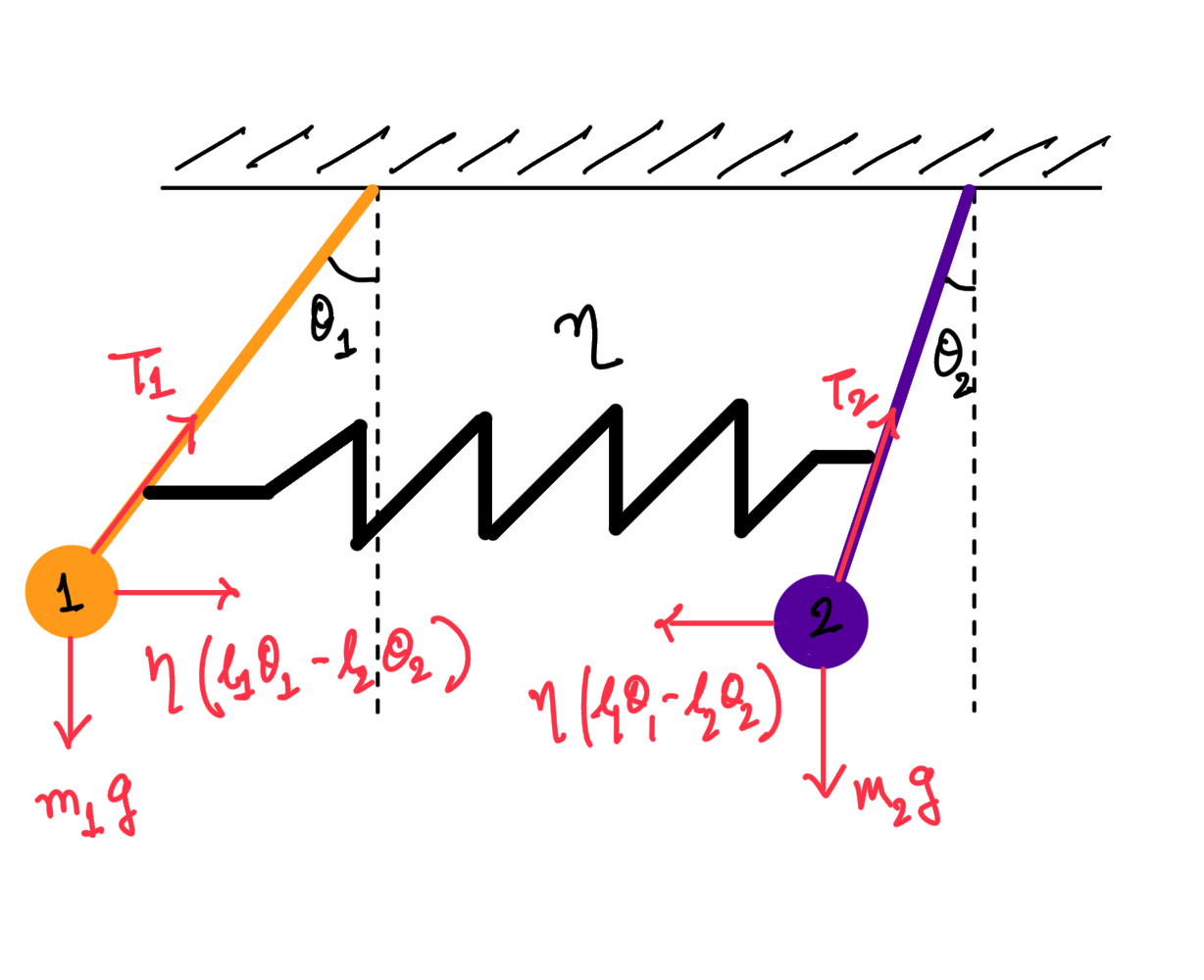
Variables
- $m_1, m_2$ — masses of pendulum 1 and 2
- $l_1, l_2$ — lengths of the pendulum rods
- $\theta_1, \theta_2$ — angular displacements of pendulum 1 and 2 (measured from vertical)
- $\ddot{\theta}_1, \ddot{\theta}_2$ — angular accelerations of pendulum 1 and 2
- $g$ — gravitational acceleration
- $\eta$ — coupling constant, describing the restoring force due to the spring (or coupling) between pendulums
- $\omega_1^2 = g/l_1$, $\omega_2^2 = g/l_2$ — natural squared frequencies of the uncoupled pendulums
Applying Newton’s second law ($F = ma$), we can write down the equations of motion for pendulum 1 and 2.
$$ m_1 l_1^2\ddot{\theta}_1 = -m_1 g l_1 \sin{\theta_1} - \eta(l_1 \sin{\theta_1} - l_2 \sin{\theta_2}) $$ $$ m_2 l_2^2\ddot{\theta}_2 = -m_2 g l_2 \sin{\theta_2} + \eta(l_1 \sin{\theta_1} - l_2 \sin{\theta_2}) $$
These equations can be neatly expressed in a matrix form, making the symmetry of the problem clearer.
$$ \begin{pmatrix} \ddot{\theta}_1 \\ \ddot{\theta}_2 \end{pmatrix} = \begin{pmatrix} \omega_1^2-\eta & \eta \tfrac{l_2}{l_1} \\ \eta \tfrac{l_1}{l_2} & \omega_2^2-\eta \end{pmatrix} \begin{pmatrix} \theta_1 \\ \theta_2 \end{pmatrix} $$
If you’re worried about not knowing or forgotten linear algebra to solve such coupled systems, don’t sweat it! Instead of grinding through the math, here’s a visualization of the solution.
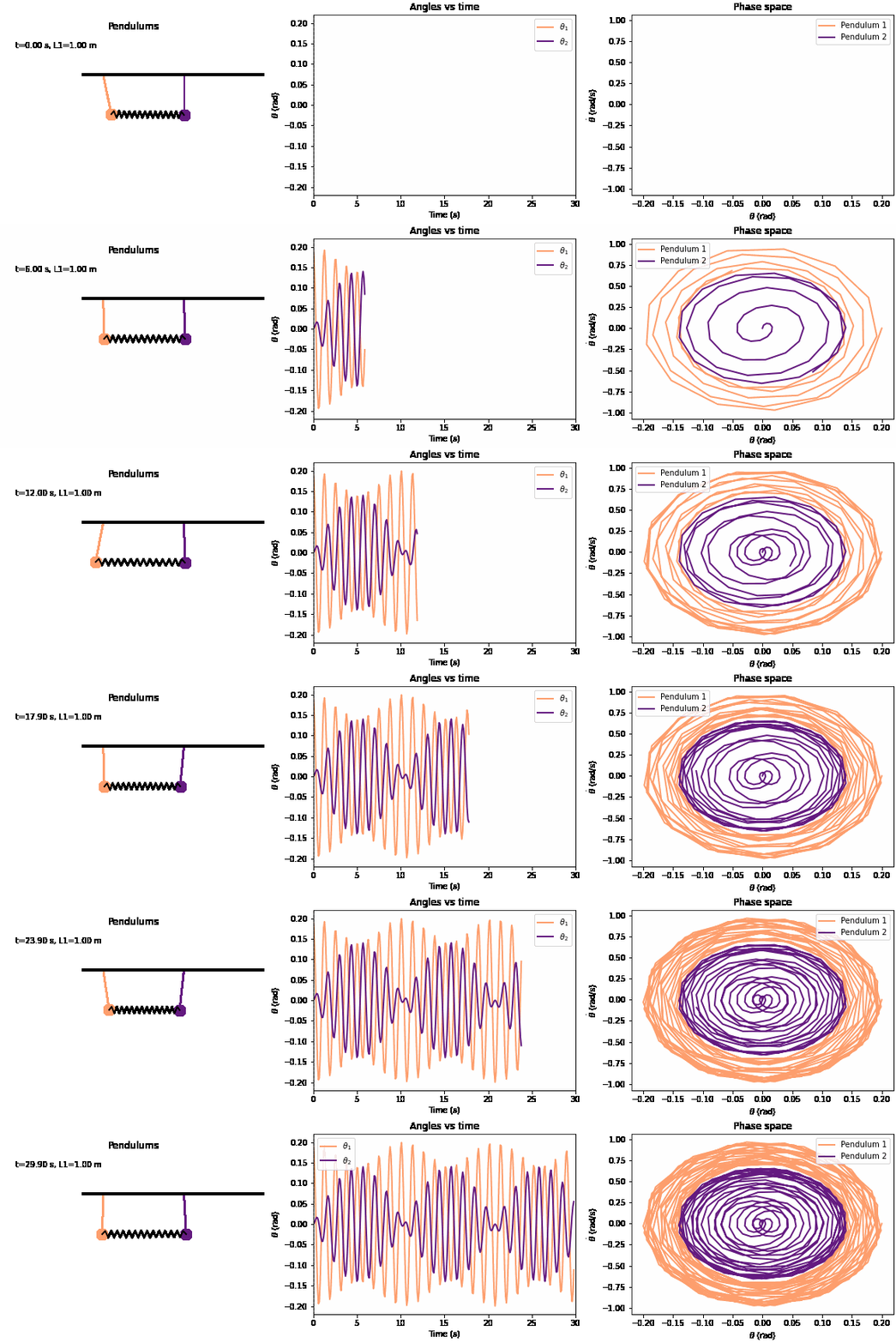
As advertised the energy from pendulum 1 transfer to pendulum 2 periodically with the total energy of the system remaining constant of course.
Step 2: Adding a Twist—A Length Changing Pendulum
Now let’s make things more interesting. Suppose the length of pendulum 1, $l_1$, changes slowly with time, going from some initial length $l_i$ to a final length $l_f$ over a duration $T$. This means its natural frequency becomes time-dependent:
$$\omega_1(t) \propto \frac{1}{\sqrt{l_1(t)}}.$$
You can imagine someone slowly letting out the string of pendulum 1 at a rate $\alpha$. We have also taken the spring constant $\eta$ to be small, in anticipation of the feeble interactions of DM with ordinary matter. Once again, we can write down similar equations of motion, and here’s what the solution looks like:
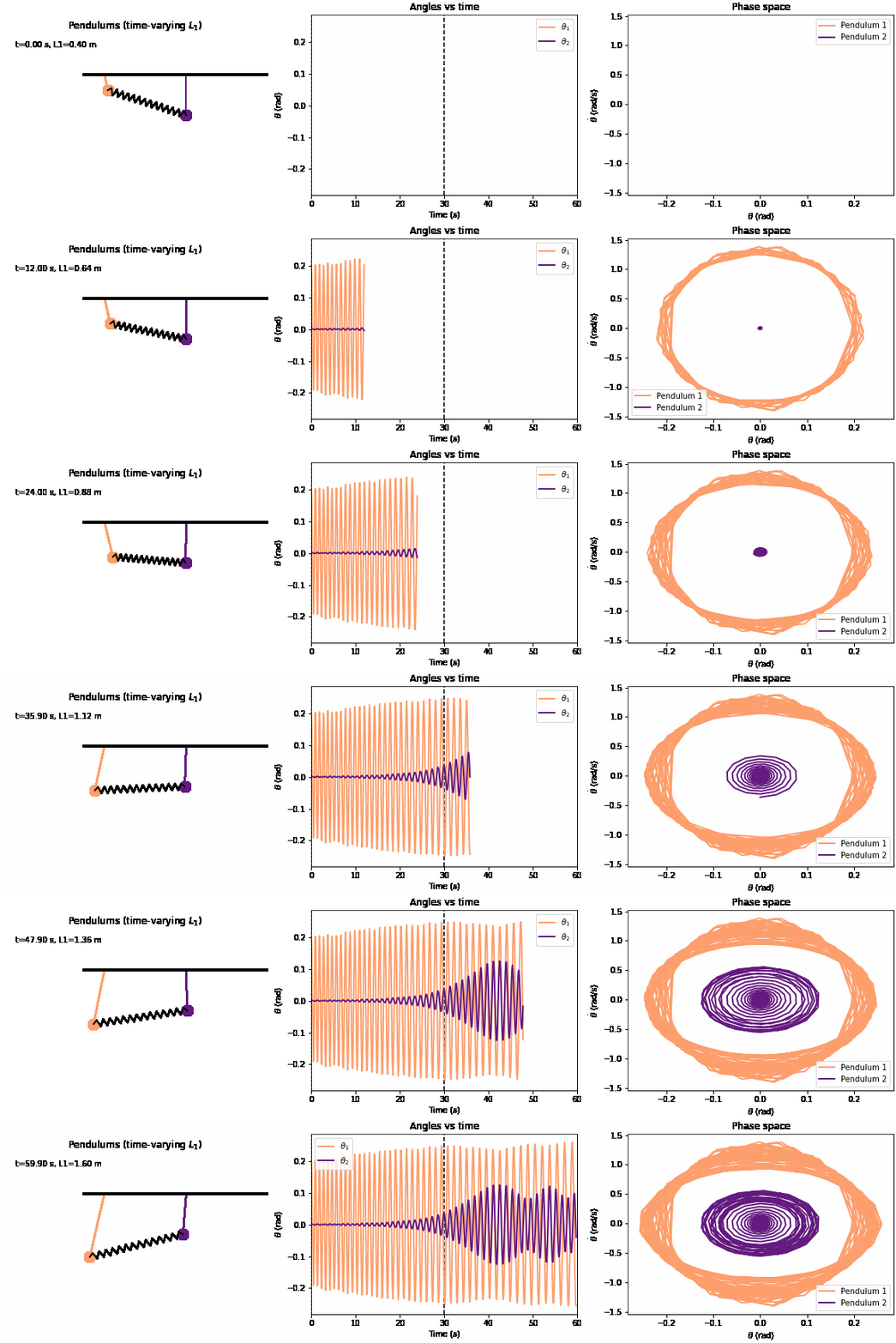
The key observation: when the lengths of the two pendulums become equal ($l_1 = l_2$), the oscillations in pendulum 2 suddenly grow rapidly. In technical language, energy is being transferred resonantly from pendulum 1 to pendulum 2. The resonant condition is when
$$\omega_1(t_\text{res}) = \omega_2,$$
with $t_\text{res}$ marking the time at which resonance occurs.
Step 3: From Pendulums to Dark Matter
Here’s the exciting part. Some dark matter candidates (such as axions and dark photons) can couple to light (ordinary photons).
Think of it this way:
- Oscillations of pendulum 1 → ordinary photons
- Oscillations of pendulum 2 → dark matter particles
In vacuum, photons are massless, zipping along at the speed of light with refractive index $n = 1$. But in a medium, photons acquire an effective mass, equivalent to the refractive index shifting away from 1. As the photon moves through regions where the medium’s properties (density, temperature, etc.) vary, this effective mass evolves, just like $\omega_1(t)$ evolved with the changing pendulum length.
At the special point when the photon’s effective mass matches the mass of the dark matter particle—
$$m_\gamma(t) = m_\text{DM},$$
energy transfers resonantly between photons and dark matter and voila you have created dark matter out of light! You can carry out the exact same logic with
- Oscillations of pendulum 2 → ordinary photons
- Oscillations of pendulum 1 → dark matter particles
thereby creating light out of dark matter!
Step 4: Why This Matters
This photon–dark matter interconversion is a central theme of my research. If dark matter particles can turn into light, we can look for unexpected light signals in telescopes and detectors. Conversely, if photons disappear by converting into dark matter, we can search for missing signals that shouldn’t vanish.
This framework has already given us some of the world’s leading constraints on dark matter, and I believe it has the power to reveal even more. For more details checkout my research page.
In short: the humble coupled pendulum experiment you might play with in school is more than a neat demo, it’s a window into how physicists are probing one of the biggest mysteries of the universe: the nature of dark matter.